
Welcome to Barbee's Blog!
A Window On My World

This is not a daily blog.
Posts will be published on occasion and irregularly as I am able.
Some of these posts are from my web site The Garden At Crocker Croft.
Barbee's Little Shop Is the sales branch of my blog and web site. divider
Showing posts with label *C: JOURNALING. Show all posts

Tuesday, April 27, 2010

Sports - Not the Vegetative Type

We are having the usual series of Winter's returns that are locally referred to as: Redbud Winter, Dogwood Winter,and now Black Locust Winter, with Blackberry Winter just around the corner. Most folks hope Winter won't tarry too long; they do not like it when Winter comes back to visit Spring. Here's hoping Spring sends Winter (in all her snowy ermines) packing for good. This one will be a wild winter to remember, as they used to say: "One for the books." I wonder... did that mean for the records - a record breaker?

I have never been a sports fan. So, it is ironic how many sports events I watched on television this past winter into spring. You know I am surely sick if I watch them, and I was.

First there was the head and sinus cold. Several weeks later there was a flu-like virus (Yes, I had both flu shots which kept me out of the hospital, I think.) that hung on and on and on; as one blogger labeled it "the bad cold from 'the hot place'". I don't like being bored, but when I feel rotten, I tend to collapse, unable to do much, if anything. It is rather bad when one has to depend on television to stay sane, but that is where I turned. Sports was the only thing worth watching, and I don't even care for sports! I even watched one of our local university's football games; it took for evvvvvver! (We are better known for our basketball. I use that "we" very loosely - remember, I don't follow sports.)

Then basketball season was upon us. The University of Kentucky main campus is here in town. It rules the town. Newly arrived citizens are quizzed as to what color they bleed. The correct answer is: blue, Kentucky blue. Rather silly, don't you think, but the locals (and not so local) get a lot of fun and entertainment from it. The hype and competition is outrageous. The place goes wild!

The Olympic games were a life safer. From the opening ceremony through the closing ceremony, I watched every day and every night; I even watched hockey - both men's and women's - I still can't believe I did that. I learned about curling. I became conversant with which team played which teams. I learned athletes by name, first names, too! I cried when they cried. I laughed when they laughed. What would I have done without them all those days and nights.

Let me make a small correction: there were two nights in February that I did not watch Olympic games. Every year we watch the Westminster Kennel Club Dog Show which is staged in Madison Square Gardens in New York City. It is televised for two nights, and is an historic sporting event reputed to be second oldest in the U.S., second only to the Kentucky Derby.

After the Olympic games, it was back to basketball for distraction. Both our women's and men's teams were having an outstanding year and went into final games which were frequently cliff-hangers. I do not know enough about it to write more. I got the impression they did very, very well, almost making it to the final game. Or, maybe they did, I can't remember. You can tell how impressed I was. But, everyone else was really excited.

And now, here we are back around. Football players and coaches are back in the news. And the holy day in Kentucky is upon us. The Kentucky Derby is always held the first Saturday in May. Is anything else happening in the world?! Hard to know around here. Keeneland Racetrack here in town runs first. Then, it is on to Louisville for the Derby.

Guess what! In September this year, Lexington is host town to the World Equestrian Games. Shades of the Olympics! Here we go again, and nothing, absolutely nothing! will be normal around here until that is over.

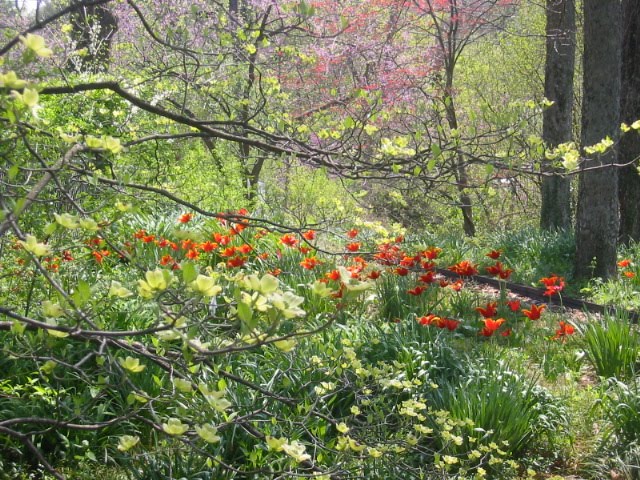
So much for sports. Here are some pretty pictures from the early spring garden. Now THAT, I do like.

Looks like University colors.
(They were really purple, not blue.)

A Sweet Thing

Helleborus "Lenten Rose"

Chionodoxa "Glory of the Snow"
Stars among the Muscari "Grape Hyacinths"

Toad house (hopefully)

Puschkinia "Striped Squill"
Floating in a sea of maturing Eranthis foliage.

Three photos of miniature Narcissus "Minnow"


The big guys looking south as usual.
Normal size "Daffodil" Narcissus.


An early crocus

Helleborus foetidus "Bear Claw"


Saturday, November 07, 2009

Autumn Stroll

First I want to thank all of you who helped Suzanne McMinn by voting for her to get the job she dearly needs. If you are like me, you would like to know some followup.

Suzanne won the first round thanks to you and many others who voted daily. She had 18,632 votes. The runner-up received 11,506 votes. That put Suzanne 7,126 votes out in front. Yes, she has a huge readership, I hope Sam-e takes note of how much traffic she would bring to their site.

The second round requires the top 20 applicants to produce a short video (I think she said 90 seconds.), write an essay, and go through another round of voting.

We can visit SAM-e.com from Tuesday, November 17, 2009 – Monday, December 7, 2009 to vote for our favorite of the top 20 candidates. http://www.sam-e.com/ I will be there and hope you will, too.

And now for the show!


The weeping crab-apple is full of fruit this year. The fruit of this tree is not as astringent as that of the other crab-apple trees. The birds and animals love it once it freezes and goes soft.


The Leatherleaf Viburnum is practically evergreen here, but it will turn brown later when the temperatures are more severe;

while the asparagus has already turned into a golden nimbus.


The Goldflame spirea turns into a variegated shrub, pretty little thing.

There is no doubt about what provided this carpet!
Red Maple
on city property in middle of street.


Some Burning Bushes, also known as Winged Euonymus, (Euonymus alatus) are pinkish,


most are bright red in the landscape,
(Burning Bush and Dogwood Tree)


while others look burgundy. The ones in front of our house would grow large as the house if allowed. I wait until they have finished their autumn show and leaves have dropped, then I have someone prune them back severally. Also, in this photo is our only remaining sugar maple street tree. It is probably the prettiest one on the street. I think I know why. Last summer we realized our sewer line between the house and street was broken and the tree had roots growing into the large drain pipe, so it got plenty of water and nutrients daily for no telling how long!

Sugar Maples are my favorite in the landscape. However, I have read that the red maples are more aggressive and they are killing out our native Sugar Maples in the forests, turning the woodlands predominately red instead of their natural oranges, yellows, and golds.

Even worse is the vigorous Norway Maple which is extremely prolific and produces hundreds of viable seeds annually. It is still sold on the market, as are other species that are on the Federal and states' invasive plant lists. Predictions are: that in time North America will lose its diversity of tree species as the dominating species beat out the natives until it becomes like Europe in that it has only a few species in the natural forests. What a loss that will be not only for the maple syrup industry, but for future generations of school children! I can't imagine not getting to study all kinds of trees and collecting from a wide range of tree species for their leaf collections for school and maybe scouts.

Until then let us visually and mentally wallow in the riches of our Sugar Maples' beauty.


View from our front porch.


Sunday, October 04, 2009

Wheel of Thyme

When we last left E-Bed 2 there was not much left in it. That was necessary so a new idea would have room to bloom. For years I harbored an idea while I watched for a wheel that I could acquire to be the basis of my new design. I wanted to create a "Wheel of Thyme", and surround it with plants that move and bloom at different times of day and night.

I found a pair of large iron wheels on Craig's List this summer, and struck a bargain with the seller. All the while I was wondering what I could do with the second wheel.

We spent all one Saturday collecting them. First we discovered they were too large to fit anywhere in my large car. OK, find granddaughter and ask if we can borrow her pickup truck. She was at work as a swimming pool lifeguard, and couldn't leave her post. We drove across town, waited until a friend could find the keys, swapped keys, left the car, took her truck, had fast food lunch, drove to storage unit again, seller helped load the wheels, drove to the house, unloaded, and as a thank you gift... filled truck's HUGE gas tank for granddaughter, then drove back across town to the pool, and swapped vehicles again. The day was shot, but I had my wheels!

I knew I wanted one flat on the ground where it could be planted with different types of thyme. The other one... hmmmm... I knew I would need a vertical something to grow morning glories on. Would this second wheel work? How would we make it stand alone? The damaged section of the wheel was buried, then re-bars were cut to fit and driven deep into the soil. I hope it will remain standing when it is full of foliage and a strong wind blows. If you want to see the metal bars, just enlarge the photo by clicking on it.

So far it is still standing. I had some puny morning glory plants I had started from seed that were still in their pots (poor things); they were set in with the wheel. I thought they might die, but they are still living and blooming on the wheel. They latched on right away and started growing on it. (Notice daylilies behind wheel.)


It was late August which meant that my growing season was winding down, but I was able to find plenty of thyme. We were leaving the labels there for a little while until I learned to recognize their faces. We planted:
woolly thyme (Thymus pseudolanuginosus) which is easy to recognize because it is fuzzy;


culinary thyme (Thymus vulgaris) which is tallest and thinnest so far;


and, Mother-0f-Thyme elfin (Thymus serphyllum)


I was not sure how they were using the name "elfin", so I looked it up and found it means "small and delicate", which is suitable for this tiny leaved, flat growing plant. I wonder why they call it "mother of thyme". Could it have been the species plant from which cultivated varieties were started. There are so many things I wonder about.

These are some of my wonderful helpers from the university here in town. Their fields of interests are: sports (track), animal science, and merchandising. None are studying anything about plants, but these are young people who want a chance to get out of doors and be partners with nature. We gardeners understand that, don't we.


When it came to preparing the actual wheel of thyme I wanted to try to duplicate the way we built the little raised bed for tiny plants. I do not have a true trough garden, so this was an improvisation.


We mixed coarse sand, compost, a little soil, and limestone that had been crushed to small pieces. After plants were set in, they were mulched with more of the crushed limestone.

The "trough" bed was successful almost to a fault, therefore we did the same mix for the Wheel of Thyme. When I planted an ornamental thyme in the raised bed, two years later it was taking over and choking out the precious little fame flower that had been doing so well.

Click and enlarge to see the beleaguered fame flowers.


Fame Flower is a native plant.
(Believed to be: Phemeranthus calycinus)


After that part was completed the rest of the whole bed was mulched with a good dark mulch.


Visible in the photos are some
Portulaca plants that had been barely hanging onto life in pots in the potting area.


The next stage of the project was, and still is, to fill the rest of the bed with flowers that move and bloom at different times of day and night. The
Portulacas do not open until noon. Morning glories are open in the early morning.


Some daylilies were not moved to the new bed halfway down the hill. They are behind the vertical wheel. They open about noon. (I think.)

Four o'clocks were planted among them. (white, yellow, and pink) I had started them from seed, and they were so, so glad to get out of those pots - remember it was August.


It is later now and the morning glory has filled out happily and is pretty each morning. Sorry, this pic is later in the day so no blooms here.


A sundial has been added that shows Father Time, and the first part of Browning's sweet verse:
“Grow old along with me! The best is yet to be, the last of life, for which the first was made. Our times are in his hand who saith, 'A whole I planned, youth shows but half; Trust God: See all, nor be afraid!'”


Nowadays the thyme looks like this and already needs weeding. Tomorrow the labels will be removed.


We have room for more plants to be planted come spring.


I have been making a list of plants that could be included. So far this is the list:
morning glories (morning)
4o'clocks (afternoon)
daylilies (noon approximately - as far as I can tell)
moon flower (night)
passion flower vine (night?)
evening primrose (at dusk with the fireflies)
Night-blooming Cereus
angel's trumpet (night?)
fame flower (afternoon)
Jewels of Ophir (afternoon)
Portulacas (noon?)
chicory (night? early morning? too weedy?)

If I made an error in my list, or if you can add to the list, please leave a comment with your suggestions. I would love to learn more.