Barbee' seemed to disappear along about August last. Things were happening... not writing, but other things. What's wrong... where was she... what's happening... did she drop in a hole? Kentucky does have all those limestone sink holes. Did the ground open up and swallow her? Did she forget how to type?! Barbee', are you OK?
----------------------------------------------
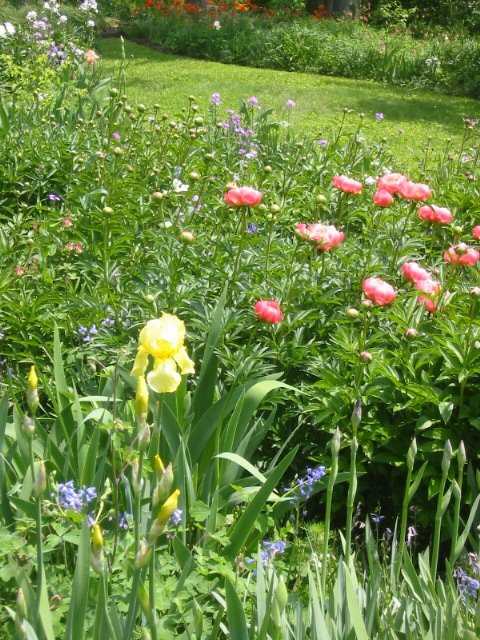
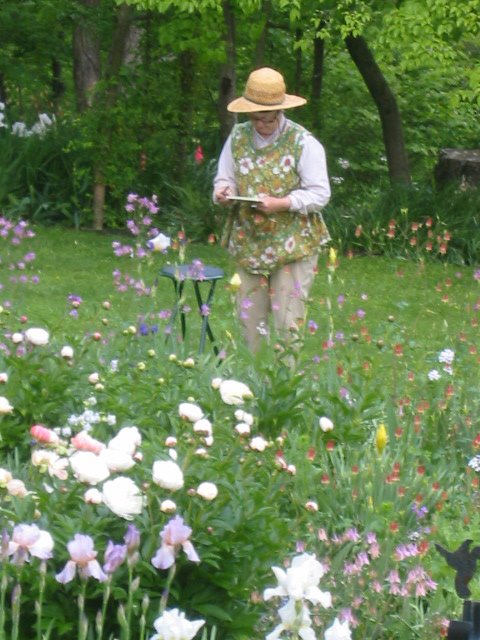
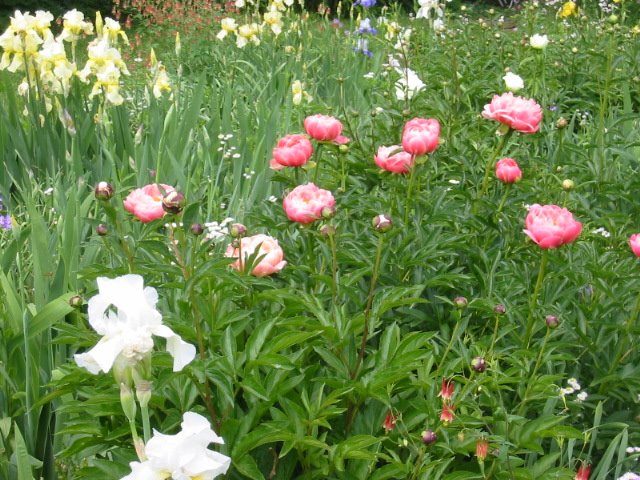
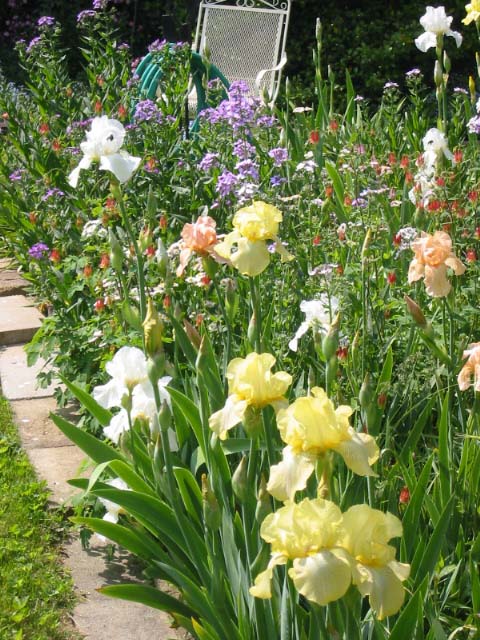
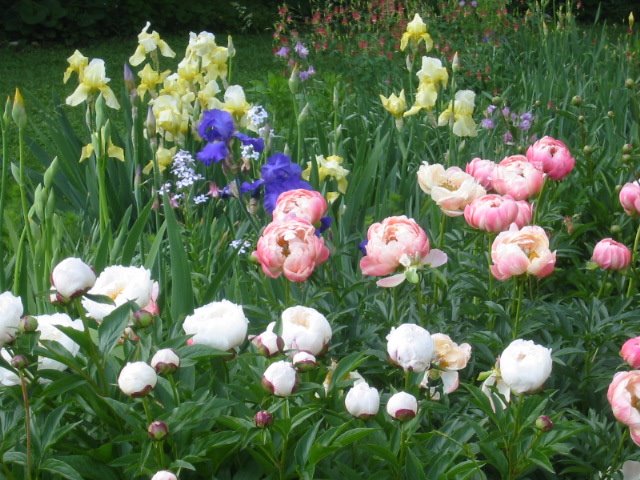
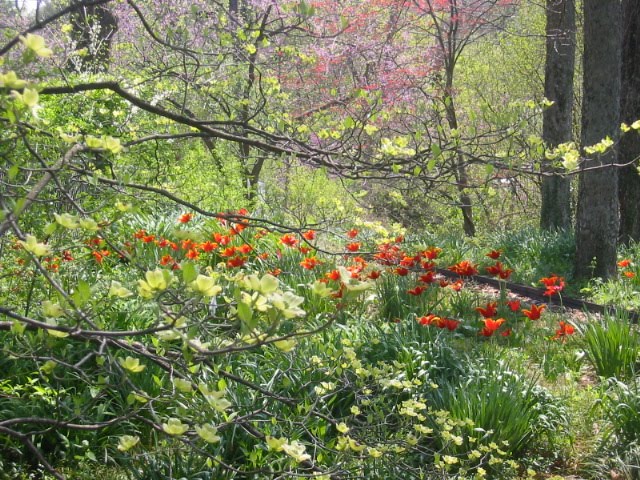
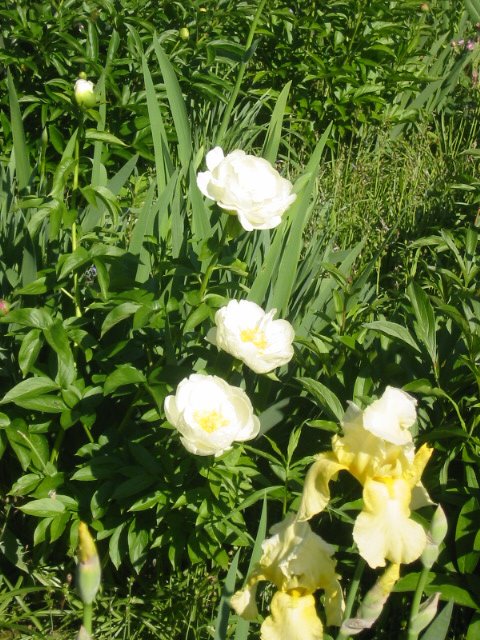
Notice: The following photographs are not of the garden this year (2009).
----------------------------------------------
The oppressive heat of zone 6's spring, summer, and early autumn kept heat-sensitive me running to the cool basement family-room before I could faint. Outdoors, it didn't take long for me to grow faint and dizzy. The young people looked at my scarlet face and wondered. They kept going. I couldn't tolerate the heat long enough to do a good job of supervising. Back to the basement. Making some good use of my time I managed to write a little - very little - my mind was out in the garden where little was being accomplished. The pile of years and cup of health drying up pulled me down.
And then, cooler weather finally arrived. Whew, what a relief! A grand push was made to re-do the Island Bed. (Remember the iris project?) I thought this might be the year, and the time! Things were falling together: Some irises had been moved in early summer; I had two new part-time helpers, one was good at details; the weather was cool enough for me to bear; the soil was dry. We began.
The challenge:
The Island Bed has two rows of peonies extending the full length of the bed. They have never been well cared for, because I could not reach them when they needed deadheading and weeding. That is because the bed is solid with spring bulbs that have multiplied over many years until they are solid. As a result, the bulbs have gone to grass (as it is called when they get too crowded, produce foliage, but few flowers). The bloom ratio to foliage is fewer each year. They have needed thinning for many years, that is, the new young bulbs sorted out and the large mature bulbs planted back in.
First to bloom are the Daffodils/Narcissus, and grape hyacinths. (Notice how the March wind deposited a white chair in the Island Bed, and tipped over the green metal chairs.)


As they begin to fade...

they are followed by the English Bluebells, Spanish Bluebells, and, I suspect, hybrids of the two.


Further challenge:
As if that were not enough, there were overgrown irises throughout on top of the spring bulbs. A mess? Absolutely!



If you click on the following three photos and enlarge them, you will be able to see the fading blue and white bluebells mixed in the whole bed, and the ball shaped buds of peonies. That bit of red is a tulip that squirrels relocated from elsewhere.


Because of the large size of the bed, and volume of irises and bulbs, I knew it would be a bear to tackle!
 I had put it off nearly twenty years, but it began to look as if it might be do-able at this time. New beds had been prepared the past two summers. In early summer, an experienced helper moved approximately a third of the irises to the new locations. That gave me encouragement.
The new, detail-oriented helper was assigned the task of laying out steppingstones to make three paths alongside the peonies. First she had to take up all the irises in the paths, then weed and dig up the bulbs that were under the irises. I told her if any remained down deep underneath the concrete pavering blocks that she was placing, they would just have to come up under them and eventually die. The project being such a behemoth, that would be the best we could do.
I stretched a string the length of the bed to mark one side of the path. For paths numbers 1 and 3 that worked quite well. Path number two, the one running between the two rows of peonies, was a bit of a challenge. The rows of unkempt peonies were not straight. Dropped seeds had produced new plants, and old ones had enlarged in girth over the years. The rows were blurred.
To make matters worse, the perennials had been cut back to 3 or 4 inch stubs. They all looked alike! Is that peony, or ironweed?! Do we dig it, or avoid it? Frustration! They all look like peonies, but not sure... lets leave them until spring when we can make a positive identification. I looked at old photographs to see if I could determine what was what. Patient Helper was asked to make swerves around some out-of-line clumps. She wanted to make the paths aesthetically pleasing, and was not happy with the way the middle one looked. In hopes she would not be too unhappy and fret, I told her: Once the foliage grows in the spring, the paths will not be seen. So far, so good with the paths.
In the meanwhile, the other new helper was set to removing irises in section A. (We tried to keep the groups of irises separate in hopes of keeping colors separate.) Then he dug weeds and spring bulbs sorting them by categories: daffodil/Narcissus and English bluebells.
While he did that, I worked on the iris plants that he had removed. They had never been thinned. It required a lot of cutting back foliage, peeling off old dead foliage, and pruning of rhizomes to remove old and diseased parts. All of that was sent to the landfill tied up in plastic bags because they surely contained eggs of iris borers.
My next step was to clean them in a bucket of water. Next they were soaked in a bucket of water with a small amount of chlorine bleach for thirty minutes. Then they were rinsed in clear water. By then they looked pretty good, so I spread each group on the sun warmed backdoor steps; one group to a step. After they dried for two days, I bagged them in plastic bags.
That process went on for days on end. I had the help of a third person for a few days, so he was the one who set out irises and bulbs into new areas. I sent an e-mail message to homeowners in this neighborhood offering free bulbs. I gave away hundreds.
At that time the soil was the texture of loose sand, we could take up a handful and spill it through our fingers like sand; we felt as if we were working in a desert.
Some days the high temperatures returned and I could not work. So much to do! and I had to stay in the cool basement.
The plan was:
(1) Clear out Section A, plant some of those in new areas, save the best to plant back in, and give away as much as possible.
(2) While I was working on cleaning those irises and giving away bulbs as much as I could, Section D would be cleared. Some of its plants were added to the give-away pile.
(3) By the time it was clear, plants from A would be ready to be planted into D.
(4) Plant into D. Meanwhile, I would work on cleaning and sorting plants from D. When that was done...
(5) they would be planted into A.
(6) During which, I, and only I, would work on B and C where the peonies grew.
It never happened.
Section D was never finished of removing the bulbs, and weeds.
(Look at the plants, not the woman in the funny sweat band and hat, and sweat drenched clothes!)
Before...

Now... Sections A & B, left and center paths:

Sections C & D, center and right paths:
 Section D, right path: You can see where he stopped when the rain began.
 Almost halfway through the whole process, the autumn rains began. And that was the end. The gate of opportunity was slammed in my face.
 The good bulbs never got planted back in. Right now there are dozens and dozens of uncleaned iris plants and bulbs sprouting in plastic bags in the garage. To prepare a virgin area for a new bed and plant it out must be a great joy, I will never know. To wrestle with an old one and try to restore it is an onus. If I were young, strong, and energetic perhaps it wouldn't be quite so bad.
I knew we were racing against nature's clock, but I had to take the risk. Did I ruin the bed? Come spring will it be pathetic looking? Will it be salvageable? Your guess is as good as mine.
Once the autumn rains started with such an immediate heavy handed onslaught, we soon realized there would be no mild, forgiving winter this year! Immediately, day after day, we have had either heavy rain, ice, or snow, or all the above almost every day since then. Drab, cold, wet winter weather slammed the door on me and my plan while it was still autumn.
Only the calendar noted the difference when autumn slipped and slid into winter.