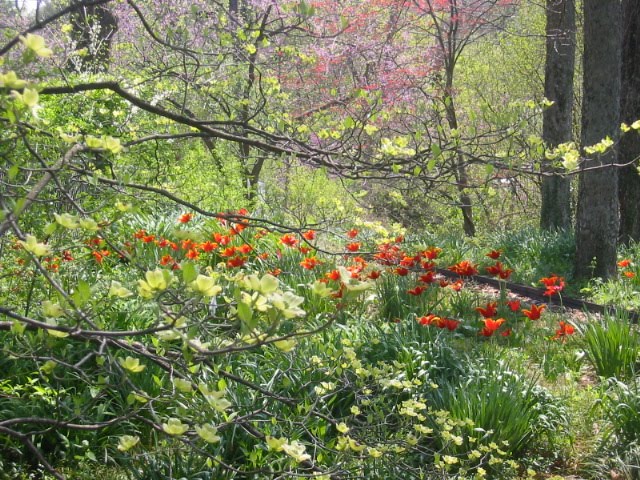

Of course, as you gardeners know, I will end up picking up sticks, pulling a weed, and making mental notes. By the time I return, I am in a mental and emotional frenzy because I saw so much that needs to be done. It is like housework: I see only that which needs to be done.
But, today, let us, you and I, stroll the estate and chat a bit. I am tired from a super busy yesterday that involved keeping a restless, energetic, thirteen year old grandson happy enough until his parents returned from work. (This is the same grandchild who years ago said with a grin, "Come on, Bobbie, get in the water. It is more fun being a kid than being an old granny!")
Yesterday, all I had to do was drive the car, walk a lot, listen a lot, talk a little, and eat lunch where he wanted: at the bar of a nice restaurant. Sitting at the bar was something different, and he wanted to do that; I said OK. He was surprised. He also knew he could order anything he wanted on the menu. What fun for a kid, to be out with a pampering grandparent.
So, there we were, sitting at the bar, having fun, laughing, eating and watching the Florida and Louisiana women's softball teams battling it out on TV. But memories kept floating to the surface of my mind. I was thinking: He is almost fourteen. There will not be many more days like this one, just the two of us, having fun. He will grow away from me. I remembered all those diapers, and toy cars and trains, and.... I better stop this right here or I will get maudlin. Anyway, I am tired, so a stroll will be just the thing for today. Remember you can click on the photos to enlarge them.
You will notice different treatments for edging. Mary used old brick and some of that is still here.
These three photos are from the E-Beds.
 Yes, that is potatoes growing in the can - but that's another story.
I especially enjoy the old bricks in late winter and early spring when they have had months of cool moisture, and moss grows and blooms on them.


I added man-made concrete pavers along the Island Bed.

 I was trying for a mowing strip that the wheel of the mower could run on with hopes of not having to do so much trimming. It helps, but it still does not keep grass roots from running under them into the bed, and we still have to do some trimming. I like the look, though.
Another edging material I have used is the long rolls of recycled rubber tires material. I have used yards and yards of that for long expanses. Sometimes a weed comes up through it (but not often) which surprised me. It, too, does not stop all the grass and weed roots from going into the beds and borders, but it helps. The visiting cats prefer to walk on it, and it is soft to kneel on.
I was afraid I would hate the dark black, intrusive, artificial appearance, but it isn't as bad as I feared it would be. The lawn mower covers it with cut grass and dirt lands on it to the point its appearance became muted.
 The flowers you see blooming here are Hyacinthoides non-scripta, common (English) bluebells. I preferred the lovely old name, Scilla, but knowledge marches on; they were taken out of that group, now they are Hyacinthoides. (Try saying that quickly three times.) We have white, blue, and pink. Their foliage is strap form. The fuzzy foliage with them is Nigella (Love-in-a-mist) which blooms soon after the bluebells. This Nigella is blue. There are also pink and white forms, but I do not have those.
The large Leatherleaf Viburnum is pretty this year. It is located at the edge of The Terrace.


Another Viburnum blooming now is the one I call Snowball Viburnum. When I was a child I heard the adults refer to them as Snowball bushes.
 We have two more varieties of Viburnum:
American Highbush Cranberry Viburnum (Viburnum trilobum a.k.a. Viburnum opulus L. var. americanum Aiton) I do not have a good photo of it, but here is a link to good ones. Scroll down their page to see the various parts. The full length shrub photo is near the bottom. Cranberry Viburnum
The other is Arrow-Wood Viburnum (Viburnum dentatum) here is a link to this one: Arrow-Wood
The lilac is young and in its third year of bloom. I need many more lilacs! This one is Syringa 'Krasavitsa Moskvy' with pink pearls in bud, opening to pure white. The combination of buds and flowers is beautiful.
 One of the earliest peonies to bloom is 'Coral Charm'. It is coral in color and receives many comments from visitors.
While 'Coral Charm' is in full bloom, the round ball-shaped buds can be seen on the other peonies that are getting ready to open soon.
 This small round bed used to have a small slender Shad Tree in the center. Fire Blight killed the tree and the perennials have completely filled in. It is filled with spring bulbs and Hostas interplanted.
In early spring it is a round bed of Narcissuses and jonquils, and then later the Hostas emerge. In these two photos the old bulb foliage is still visible. It will soon yellow and die away as the Hostas spread larger and bloom.


Spanish Bluebells (Wood Hyacinths) pop up in several locations. I believe these and the English ones cross and produce hybrids, because there are some I can't tell if they are the Spanish or the English. I guess it does not matter here, I should not be such a purist.
Here we see the Bluebells with (from the top down): native (red and yellow) columbine; old Narcissus foliage; on the left is a young Larkspur; and the pale-green is an annual poppy that will bloom later. They are located at the front corner of the garage.

This colony is right beside the Garden Door back of the garage. I also see some Fleabane, buds of perennial Oriental Poppies, and in center front is Eranthis turning yellow and going dormant.
 Here is a closer look at the poppy buds. They are fuzzy. When they open they are large and red-orange.

 One problem with the poppies is the same as with Daffodils: they face the sun (South in this hemisphere). So, they face away from the house. These are in the Back Border and they are facing down the hill toward The Dell.
I do enjoy the red-orange with the purple of the Rocket.
 Now before some of you jump on me with the subject of invasive plants let me tell you about Rocket in this garden.
Hesperis matronalis (Dame's Rocket, a.k.a. Sweet Rocket) is listed in some states or areas as an invasive plant. I am sure it is. However, in this garden and in this neighborhood we have to take care of it to keep it going. Some of my neighbors want it, but it is not so easy to get it started here. Therefore, I do not feel guilty for growing it.
In the Woodland Garden there are early spring flowers such as the Wood Poppy, a.k.a. Celandine Poppy (Stylophorum diphyllum), a native plant, which is visible here in the Far-Back Border growing near the fence in that bare looking area. The one up high is growing on an upturned tree root ball. After the early plants flower, and are gone by, the Rocket shoots up tall and blooms away with flowers that perfume the late afternoon air.
 Our Rocket is several colors from white to dark violet/purple...
 with tints in between, such as this mauve.
 Rocket looks very much like Phlox paniculata (Garden Phlox). They grow to about the same height, but in this area the Rocket blooms earlier and the Phlox later. There is some Garden Phlox here and it extends the season for the butterflies after Rocket goes to seed. As you can see, Rocket has four petals. Phlox has five.
Goldfinches like the seeds of Rocket and will strip the seed pods to shreds.


 This Rhododendron brings us to the back door steps.
I am ready for a cool drink, how about you?
You can't stay longer? Then until next time, "Goodbye".


