
Welcome to Barbee's Blog!
A Window On My World

This is not a daily blog.
Posts will be published on occasion and irregularly as I am able.
Some of these posts are from my web site The Garden At Crocker Croft.
Barbee's Little Shop Is the sales branch of my blog and web site. divider
Showing posts with label Japanese tomato ring. Show all posts

Thursday, October 02, 2008

Dividends?


Apparently I garden to feed wildlife. The whole place is a smorgasbord. Plus, it is fun to feed the birds additional food, and watch their cute selves up close. Feeding them purchased birdseed is one thing, but it does not stop with that. I am grateful that Nature pitches in with extra help sometimes, though I suspect she is using me.

When the Funny Feeder was put back into operation during the winter, filled with black sunflower seeds, the rowdy critters wasted a lot of it by knocking seeds onto the ground. I thought the squirrels, chipmunks, and doves were cleaning it up and being efficient, but look what happened.


Following photos are after the peak of bloom,
and, after they had been thinned some.


The Gold Finches hung upside down, hidden, as they clung to the flowers while they cleared away all the young seeds; it took only two or three days - if that long. I thought there were still seeds there, until Local Son showed me they were gone! All of that mess has been cleaned up now, and the feeder post has been made plumb.

Last year we took the local grandchildren out to an apple orchard where they could also select pumpkins for autumn decoration. They each chose one large pumpkin, then they wanted a few of the miniature ones that are about the size of a grapefruit. That was fun, and they placed them on their front porch for autumn, Halloween, and Thanksgiving. I told them when the pumpkins begin to go bad, I wanted them for my composter.

Then we enjoyed Thanksgiving Dinner at their house a few weeks later. As soon as dessert was served, one piped up and said, "You can take the pumpkins home with you when you leave. Thanksgiving is over and it's time to put out the Christmas things." I nearly fell off my chair laughing, we hadn't even left the table... but that is what we did.

When I have melons, winter squashes, or pumpkins, I like to remove the seeds and put them out somewhere for the Cardinals. The small pumpkins were so little, I just cut them open and set them on the ground around the Japanese tomato ring and let the Cardinals serve themselves.
Japanese Tomato Ring before the little pumpkins were placed.
This spring a very healthy pumpkin vine appeared. As soon as the first fruit was good and ripe, something ate it. The vine was rampant and ranging: it made eighteen little pumpkins. They were lovely little bright orange orbs.

Returning home one day, I came upon the scene of a massacre. Something had struck again and eaten five more.

It was either: Bandit,


OR... Scamper


OR... Grundoon
(I once pointed out a groundhog wandering in our back yard to our visiting four year old grandchild. Then I said, "Its name is Grundoon." The child said: "How do you know?")


OR... Pogo


...probably aided and abetted by... Alvin.


We gathered up the remaining twelve little pumpkins and brought them into the garage out of reach of the critters. We had purchased three small pumpkins, and this autumn we have twelve, plenty of seeds for next year, plus six were enjoyed by marauding wildlife. Seems to be a pretty good return on that investment; or, another way to look at it would be: That was an example of working with nature, and the benefits therefrom.


Wednesday, June 18, 2008

Japanese Tomato Ring


(HOW TO BUILD INSTRUCTIONS are farther down the page... scroll down.)

Note:
This post is from my web site, The Garden At Crocker Croft.
Dated July, 2006.

This year I have another Japanese tomato ring. Had one several years ago at a different house. Didn't have a good place for one here. Tried growing tomatoes down in the dell, but they didn't do well.

Then, somewhere around 2001, "The Most Important Tree", a huge hackberry tree near the house gave in to gravity, split and fell every which way all over everywhere. What a day that was, but that's another story. Now its spot was available… and now, there was plenty sunlight.

At first, I planted a small butterfly bed in its place so we could see the butterflies from the window. The plants thrived on the soft, spongy, balsa-like decaying wood from the tree. I added homemade compost. Everything grew too tall - the purple coneflowers (Echinacea) fell over and had to be staked and tied. After a few years, I grew tired of that, so this year they were moved down into the new wildflower meadow in the dell where they are doing very well. All the while, I had my eye on that spot for growing some good homegrown ripe-on-the-vine tomatoes.

I explained to one of my helpers what I wanted, showed him a newspaper photo, and he "built" it. The plants have reached the top of the fence and are full of young green tomatoes.

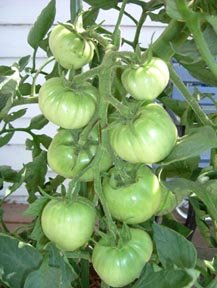
The system calls for only four plants. I chose four different kinds rather as an experiment to see which kind, or kinds, we'd like best, and which do well in that location. There is one of each variety and the varieties are: Brandy Wine, Beef Steak, Big Boy, and Better Boy.

We have high hopes of many tomato and cottage cheese lunches and wonderful bacon, lettuce, and tomato sandwiches. Tomato season is the only time of the year we buy bacon, and bologna, and one of the few times we use the mayonnaise-type salad dressing we like. We know it isn't good for our health, but tomatoes call for it. Hopefully, those few meals won't do us in.

HOW TO BUILD INSTRUCTIONS
You might like to try the system, yourself; it's quite a tomato "factory". In the Lexington, Kentucky, Herald-Leader, newspaper, April 26, 2003, writer Beverly Fortune gave the following instructions. I couldn't explain it any better, if as well, so will quote from her article:

"The tomato ring works this way: In the center of a wire ring are compost, topsoil and fertilizer, with four tomato plants around the outside. The compost keeps the soil moist and helps prevent blossom end rot. The nutrients leach into the soil during the summer, guaranteeing the plants a constant rich diet. They respond with a bumper crop of tomatoes.

Supplies:
Take a 15-foot length of wire fencing and form it into a circle about 5 feet in diameter. It helps stabilize the ring if you first drive four 5-foot iron stakes into the ground and stretch the wire around them.

In the center of the ring, spread about 6 inches of compost. Shovel in a wheelbarrow of good soil.
Add half of a 10-pound box of balanced fertilizer (10-10-10).

Make the pile slightly funnel-shaped in the center to hold water.

Repeat these three layers.

Plant just four tomato plants around the outside of the ring. Water outside the ring when the plants are small, inside the ring as they become large. As the vines grow, tie them to the wire with strips of soft rags." (End Quote)

I use metal fence posts for a more permanent installation, then set the plants at the posts and tie them to the posts for more stability, and then to the fence wire as they grow and spread. Any watering I do goes into the center of the ring. The plants will run their roots into that area for moisture and nutrients. They grew so fast I got way behind with my tying up - as you can see in the photo.

Do remember: tomatoes are warm weather plants. They like warm soil and air. If planted too early into cool earth, they will sit and sulk and not grow, may even get diseased. Also, if the air temperature gets too hot, say in the nineties or more, they will drop some blossoms. Guess there's nothing we can do about that. It all sounds tricky, but it isn't really, actually quite easy and certainly worth the effort, in my opinion.


August 31, 2006

For several weeks, now, we have enjoyed an abundance of huge luscious ripened-on-the-vine tomatoes. The stems were so large and strong; we couldn't break them and had to use pruners to gather those fragrant orbs.

What a good feeling to have so many we could share with neighbors and local family - all from only four plants! Almost unbelievable.

As the season begins to wind down, I'm considering snipping the growing tips from the vines so instead of more top growth; hopefully, they will spend their energy ripening the fruit already set.

At season's end, we will enjoy fried green tomatoes, and wrap the rest individually in newspaper and let them "ripen" in a box to extend the season. They will turn red, but the quality won't be as good as when they ripened on the vine. But, that's ok, they'll be as good or better than any we could buy in the grocery stores, probably by then we'll be glad to have any kind we can get. I've read of people doing that and eating the last of their crop in November as they placed homegrown tomatoes on their Thanksgiving dinner table.

Oh! And which was our favorite? I think it was the Brandywine of pink skin and solid flesh - but the others are delicious, too.
Wish I could hand you a few.